English
More than 3,500 years ago, a remarkable woman rose to the throne of ancient Egypt and became one of the most successful rulers of the New Kingdom.
Hatshepsut was a member of Egypt's powerful 18th Dynasty who eventually took the full title and authority of a pharaoh. She ruled Egypt for roughly two decades, during a period of prosperity, major construction, religious development, and international trade.
Her story is remarkable not simply because she was a woman who became pharaoh. Hatshepsut was also an ambitious political leader, a great builder, a supporter of religious institutions, and a ruler who expanded Egypt's commercial connections.
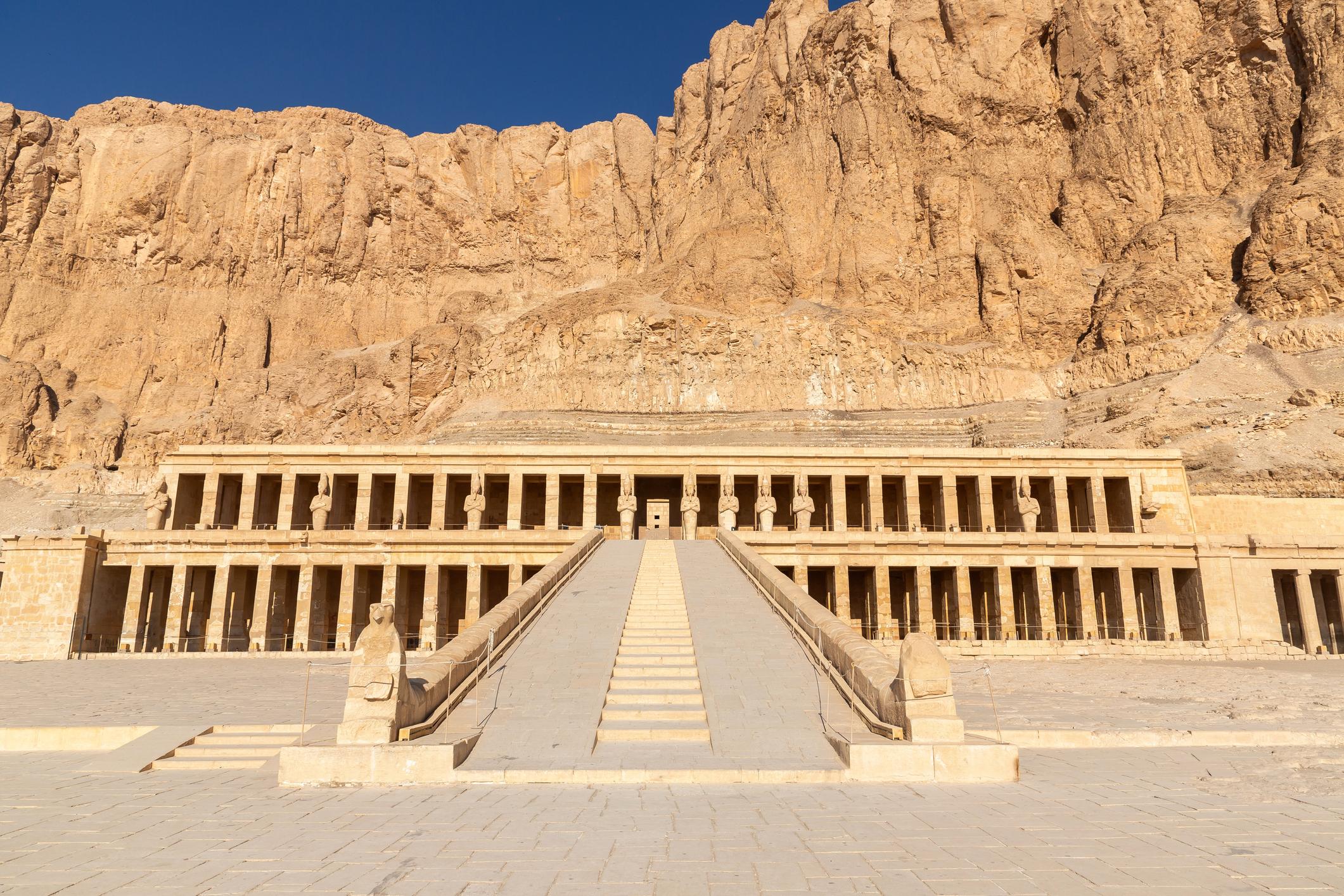
Her magnificent mortuary temple at Deir el-Bahari in Luxor remains one of the most impressive monuments of ancient Egypt.
Her life also tells a fascinating story of power, family, religion, political strategy, and historical memory.
Who Was Queen Hatshepsut?
Hatshepsut was born into the royal family during the 18th Dynasty of the New Kingdom.
She was the daughter of Thutmose I and his principal queen, Ahmose, giving her a strong connection to Egypt's royal line.
Her name is generally translated as "Foremost of Noble Women."
Hatshepsut grew up in Thebes, one of the most important religious and political centers of ancient Egypt. During this period, Egypt was becoming increasingly powerful, and the royal family controlled enormous political and religious resources.
She later married her half-brother, Thutmose II, according to royal traditions of the period.
The couple had a daughter named Neferure, but Thutmose II did not have a son with Hatshepsut.
When Thutmose II died, his successor was a young boy named Thutmose III, whose mother was a secondary wife named Isis.
Because Thutmose III was still too young to rule independently, Hatshepsut initially became his regent.
This was the beginning of her extraordinary rise to power.
From Queen and Regent to Pharaoh
At first, Hatshepsut ruled as regent on behalf of the young Thutmose III.
However, her political influence gradually increased.
Eventually, she adopted the full royal titulary and presented herself as king of Egypt, ruling alongside Thutmose III while becoming the dominant political figure.
This was an extraordinary development.
Egyptian kingship was traditionally represented through male imagery, but Hatshepsut adopted the traditional symbols of pharaonic authority.
She appeared wearing the royal nemes headdress, the traditional royal clothing, and in some statues she was represented with the symbolic false beard associated with Egyptian kings.
At the same time, some representations continued to show her with feminine features and titles.
This combination demonstrates how Egyptian royal art was more than a simple representation of physical appearance.
The image of the king represented the institution of kingship, divine authority, stability, and the maintenance of maat—the Egyptian concept of order, justice, balance, and harmony.
Hatshepsut therefore used the traditional visual language of Egyptian kingship to establish her legitimacy.
How Hatshepsut Proved Her Right to Rule
Becoming pharaoh required more than political authority.
Hatshepsut needed to convince the Egyptian population and religious establishment that her rule was legitimate.
One of the most important ways she did this was through religion.
Inscriptions at her temple at Deir el-Bahari describe a divine birth story in which the god Amun is presented as her divine father.
The message was powerful: Hatshepsut was not simply a woman who had taken the throne. Her rule was presented as part of a divine plan.
She also emphasized her relationship with her father, Thutmose I, and her position within the legitimate royal family.
Her throne name, Maatkare, was also connected to the important Egyptian concept of maat.
Through her names, monuments, inscriptions, religious imagery, and royal titles, Hatshepsut carefully created an image of legitimate kingship.
The Temple of Hatshepsut at Deir el-Bahari
Perhaps the greatest symbol of Hatshepsut's reign is her magnificent mortuary temple at Deir el-Bahari, on the west bank of the Nile in Luxor.
The temple was known in ancient times as Djeser-Djeseru, commonly translated as "Holy of Holies."
Its design was revolutionary for its time.
Instead of following the traditional appearance of a massive pyramid complex, the temple was built into the natural cliffs of Deir el-Bahari.
The monument features multiple terraces connected by ramps and surrounded by impressive colonnades.
The result is a spectacular combination of architecture and natural landscape.
The temple included religious spaces dedicated to several important Egyptian deities, including Amun, Hathor, Anubis, and Ra-Horakhty, as well as areas connected with Hatshepsut and her royal family.
Today, the Temple of Hatshepsut is one of the most famous attractions in Luxor and one of the best surviving examples of ancient Egyptian monumental architecture.
Senenmut and Hatshepsut's Building Program
Hatshepsut's architectural achievements were supported by a group of highly capable officials.
One of the most famous was Senenmut, an important official who held numerous positions within the royal administration.
He is strongly associated with the construction and development of Hatshepsut's temple at Deir el-Bahari.
Hatshepsut's building program was not limited to her famous temple.
She commissioned projects at major religious centers throughout Egypt, particularly at Karnak, where she contributed temples, chapels, statues, and monumental obelisks.
Her construction projects served both religious and political purposes.
They honored the gods while also demonstrating the strength, wealth, and legitimacy of her reign.
Hatshepsut and the Land of Punt
One of the most famous events of Hatshepsut's reign was a major trading expedition to the mysterious Land of Punt.
The exact location of Punt remains debated, but it was probably somewhere in the broader region of the southern Red Sea and the Horn of Africa.
The expedition is beautifully recorded in reliefs at Deir el-Bahari.
Egyptian ships returned with valuable products including:
Frankincense
Myrrh
Gold
Ebony
Ivory
Exotic plants
Animals and other luxury goods
The expedition demonstrated Egypt's ability to establish long-distance trade connections.
It also became an important part of Hatshepsut's royal propaganda.
The reliefs presented the expedition as evidence of Egypt's prosperity and as a successful mission supported by the gods.
Hatshepsut: A Ruler of Trade and Prosperity
Hatshepsut's reign is particularly interesting because she is not remembered primarily for military conquest.
Instead, her rule is strongly associated with trade, construction, religion, diplomacy, and economic development.
The expedition to Punt brought valuable resources to Egypt, while her building program transformed important religious centers.
Her reign appears to have been a period of considerable stability and prosperity, allowing resources to be invested in temples, monuments, religious ceremonies, and international trade.
This provides a different image of ancient Egyptian kingship from the famous warrior-pharaohs who are primarily remembered for their military campaigns.
Hatshepsut and Thutmose III
The relationship between Hatshepsut and Thutmose III has been debated by historians for many years.
Thutmose III was Hatshepsut's stepson and nephew. During the early part of his reign, Hatshepsut acted as his regent before eventually becoming the dominant ruler.
After Hatshepsut's death, Thutmose III became sole ruler and eventually became one of Egypt's greatest military kings.
For a long time, historians believed that Thutmose III destroyed Hatshepsut's monuments because he personally hated her or wanted revenge.
Modern scholarship presents a more complicated picture.
Some of Hatshepsut's statues, names, and images were deliberately damaged or removed, but much of this destruction appears to have taken place years after her death.
The reasons may have involved royal succession, political legitimacy, and the traditional presentation of kingship rather than simple personal hatred.
The Erasure of Hatshepsut
After her death, Hatshepsut gradually disappeared from Egypt's official historical record.
Her name was removed from some monuments.
Some statues were destroyed or deliberately damaged.
Certain images of her as king were altered or replaced.
Her monuments were sometimes modified to emphasize other members of the royal family.
For centuries, Hatshepsut became almost forgotten.
What makes this especially fascinating is that her monuments remained standing even when her historical identity was no longer clearly understood.
The architecture survived.
The inscriptions survived.
The statues survived.
Eventually, modern archaeology began bringing her story back to life.
The Rediscovery of Hatshepsut
Archaeological discoveries played a major role in restoring Hatshepsut to her rightful place in Egyptian history.
Excavations at Deir el-Bahari uncovered numerous statues, inscriptions, architectural fragments, and reliefs connected with her reign.
Piece by piece, researchers were able to reconstruct the story of the woman who had once ruled Egypt as king.
Her rediscovery is one of the most fascinating examples of how archaeology can recover historical figures whose identities were deliberately removed from later records.
Today, Hatshepsut is no longer a forgotten ruler.
She is recognized as one of the most important pharaohs of ancient Egypt.
The Mystery of Hatshepsut's Tomb
Hatshepsut was associated with KV20, a tomb in the Valley of the Kings.
Her burial history, however, is complicated.
A mummy discovered in another tomb, KV60, was eventually identified as Hatshepsut based on archaeological and scientific evidence.
The identification included comparisons with members of the royal family as well as dental evidence.
The discovery added another fascinating chapter to Hatshepsut's story.
After centuries of uncertainty, the remains associated with the famous female pharaoh could finally be studied using modern archaeological and scientific techniques.
Why Hatshepsut Is Important Today
Hatshepsut's importance goes far beyond the fact that she was a female ruler.
She was an effective political leader who successfully governed Egypt during one of its most powerful periods.
She sponsored enormous building projects.
She strengthened religious institutions.
She encouraged international trade.
She promoted Egypt's connection with the Land of Punt.
And she created an architectural legacy that has survived for more than three millennia.
Her story also demonstrates how ancient Egyptian rulers used religion, architecture, art, and symbolism to establish political legitimacy.
Visiting the Temple of Hatshepsut in Luxor
For travelers visiting Luxor, the Temple of Hatshepsut is one of the most impressive historical sites to explore.
Its location beneath the dramatic cliffs of Deir el-Bahari makes it visually spectacular.
Visitors can walk through the temple's terraces and colonnades while viewing ancient reliefs that tell stories about Hatshepsut's reign, her divine legitimacy, and the famous expedition to Punt.
The monument also provides an opportunity to understand how ancient Egyptian architecture was integrated with the surrounding landscape.
A visit becomes even more meaningful when you know the story of the woman who commissioned it.
Hatshepsut's Legacy
Hatshepsut's story is ultimately a story of power, ambition, intelligence, and historical memory.
She entered a political world in which the Egyptian throne was traditionally represented by men, yet she successfully adopted the authority and symbolism of kingship.
Rather than simply rejecting Egyptian traditions, she used them to strengthen her position.
She presented herself as a legitimate ruler chosen by the gods, built extraordinary monuments, supported trade, and connected her reign with prosperity and divine order.
Although later generations attempted to remove her from parts of Egypt's official history, her monuments survived.
Today, those monuments tell a different story.
They reveal the achievements of a powerful ruler who governed Egypt successfully and left behind one of the most extraordinary architectural legacies of the ancient world.
Hatshepsut: A Pharaoh Who Changed History
Standing before the terraces of Deir el-Bahari today, it is difficult to imagine that the woman responsible for this magnificent monument was once almost erased from history.
Hatshepsut's journey from royal daughter to queen, regent, and finally pharaoh is one of ancient Egypt's most fascinating stories.
Her reign demonstrates that power in ancient Egypt was not defined only by military victories. Architecture, religion, diplomacy, trade, and political strategy could be equally important tools of kingship.
More than three thousand years later, Hatshepsut remains one of the most remarkable rulers of ancient Egypt and one of the most extraordinary women in the history of the ancient world.